


The Georgetown Parents’ Complete Guide to Children's Eye Exams
The Georgetown Parents’ Complete Guide to Children's Eye Exams
Here's a stat that surprises most parents: 80% of what your child learns in school comes through their vision. Reading, writing, screen work, even sports — it all depends on healthy eyes. Yet fewer than 15% of preschool children ever receive a professional eye exam.
If your kid is struggling to keep up in class, getting headaches, or sitting way too close to the TV, the answer might not be a tutor or less screen time. It might be an eye exam.
When Should Your Child's First Eye Exam Be?
The American Optometric Association recommends a clear schedule:
* Although blink starts seeing children at 5 years and up, we recommend parents find an optometrist under the InfantSEE program for their free first eye exam from 6 months to 12 months of age. Visit InfantSEE® | InfantSEE for more information on the program.
6 to 12 months: First comprehensive eye exam (yes, really — babies can be examined!)*
Ages 3 to 5: A follow-up exam before starting preschool or kindergarten
Before first grade and every year after: Annual comprehensive eye exams throughout school years
Why so early? Because children don't know what "normal" vision looks like. A child who has always seen the world blurry won't complain about it — they think everyone sees that way. A comprehensive eye exam can catch what they can't tell you!
Vision Screening vs. Comprehensive Eye Exam: There's a Big Difference
Most Texas schools, including Georgetown ISD, offer basic vision screenings. That's a great start — but here's what most parents don't realize: school screenings can miss up to 75% of children with vision problems.
A school screening typically checks one thing: can your child read letters at a distance. That's it. A comprehensive eye exam evaluates:
How well the eyes work together as a team
Focusing ability at different distances
Eye tracking and movement
Overall eye health (retina, optic nerve, eye pressure)
Color vision
Whether a prescription is needed
To put it bluntly: a vision screening gives you less than 4% of the information that a comprehensive exam provides. And 61% of children who fail a screening never follow up with an eye doctor.
Red Flags Every Parent Should Watch For
Children rarely complain about vision problems because they don't have a frame of reference. Watch for these signs:
Squinting or closing one eye to see the board or TV
Sitting too close to screens or holding books very near their face
Frequent headaches, especially after school or reading
Rubbing their eyes a lot (beyond being tired)
Losing their place while reading or using a finger to track words
Avoiding reading or homework (it might physically hurt their eyes)
Head tilting when looking at something
One eye drifting in or out
Here's the important part: vision problems can mimic ADHD and learning disabilities. Before any behavioral or academic evaluation, rule out vision first.
What Happens During a Pediatric Eye Exam at Blink?
We get it — bringing a toddler or a squirmy 6-year-old to a doctor's office isn't always easy. That's why we make it comfortable and even fun!
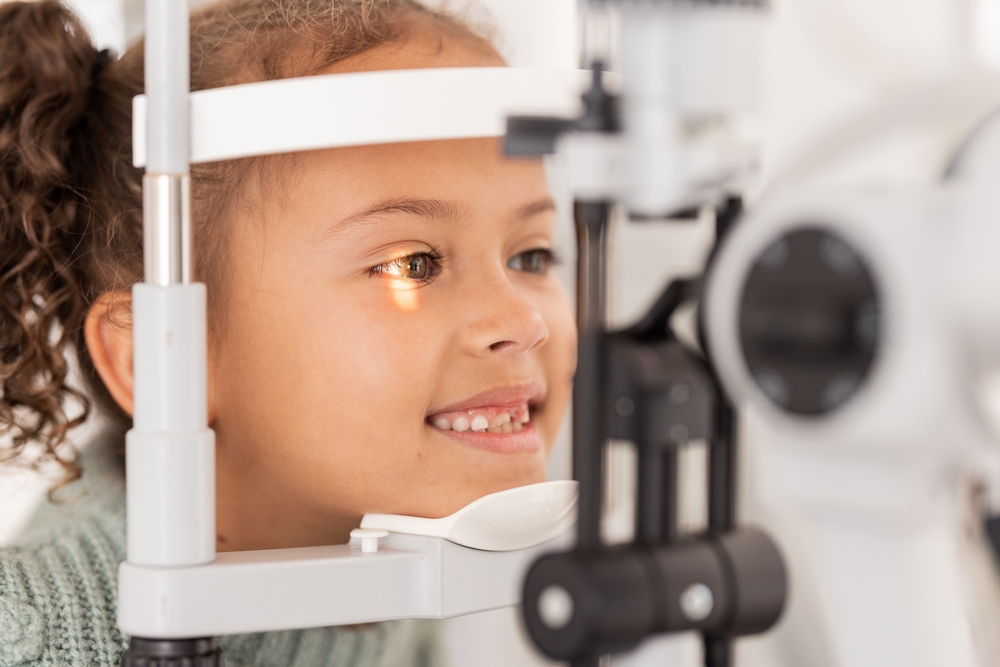
At Blink, Dr. Pham and Dr. Garza use kid-friendly techniques that don't require your child to read letters or sit perfectly still. Our advanced diagnostic equipment (and sparkling personalities) — will aid us in examining your child comfortably.
We also use our MYAH optical biometer to measure your child's eye length — a key indicator for myopia (nearsightedness) risk. If your child's eyes are growing too fast, we can discuss myopia management options to slow it down before it gets worse. (More on this in our post about the myopia epidemic in kids)
The Myopia Connection: Why This Matters Now More Than Ever
Nearsightedness in children has skyrocketed since the pandemic. More than 1 in 3 kids ages 12–17 are now myopic, up from about 1 in 4 in the 1970s. Each additional hour of daily screen time raises myopia risk by about 21%.
The good news: early detection means early intervention. The FDA recently approved Essilor Stellest lenses — the first lenses in the US specifically designed to slow myopia progression in children. We have real tools to fight this trend!
Annual eye exams are the first step in catching myopia early. We'll dive deep into myopia management in a dedicated post — it's that important!
Back-to-School Tip for Georgetown Families
Texas schools typically start in mid-August. We recommend scheduling your child's annual eye exam in June or July to beat the rush and make sure any new glasses or contacts are ready before the first day. Georgetown ISD serves over 13,000 students — spots fill up fast!
(We'll have a full back-to-school eye exam guide closer to summer — bookmark our blog at blinkgeorgetown.com/blog.)
Schedule your child's eye exam today. Book online at blinkgeorgetown.com or call (737) 225-8644
Frequently Asked Questions
Q: At what age should a child first see an eye doctor?
A: At blink we see children 5 years + however, the AOA recommends a first comprehensive eye exam between 6 and 12 months of age. Early exams can detect conditions like amblyopia (lazy eye) and strabismus (crossed eyes) that are much easier to treat in infancy.
Q: My child passed their school vision screening. Do they still need an eye exam?
A: Yes. School screenings only test distance vision and miss up to 75% of vision problems. A comprehensive exam evaluates focusing, eye teaming, tracking, eye health, and more — providing 25 times more information than a screening.
Q: How do you examine a baby's or toddler's eyes?
A: We use specialized techniques like retinoscopy (shining a light into the eye and observing the reflection) and preferential looking tests that don't require your child to read letters or give verbal responses. It's quick, painless, and often fascinating for little ones.
Q: Can vision problems cause behavioral issues in children?
A: Absolutely. Children with undiagnosed vision problems often struggle with attention, reading, and classroom behavior — symptoms that can be mistaken for ADHD or learning disabilities. A comprehensive eye exam should be part of any academic or behavioral evaluation.
Sources
- AOA — Comprehensive Pediatric Eye and Vision Exam Guidelines
- Prevent Blindness — Children's Vision Screening
- CDC — Vision Health: Children
- JAMA Network Open — Screen Time and Myopia in Children
- AAO — Eye Screening for Children
Quick Links

All Eye
Care Services

Keep
In Touch
MAP
© 2026 blink boutique eyecare + eyewear. All Rights Reserved. Accessibility Statement - Privacy Policy - Sitemap
Powered by: 
